
PUBLIC PIN BLOCKING of UNWANTED ROBOCALLS
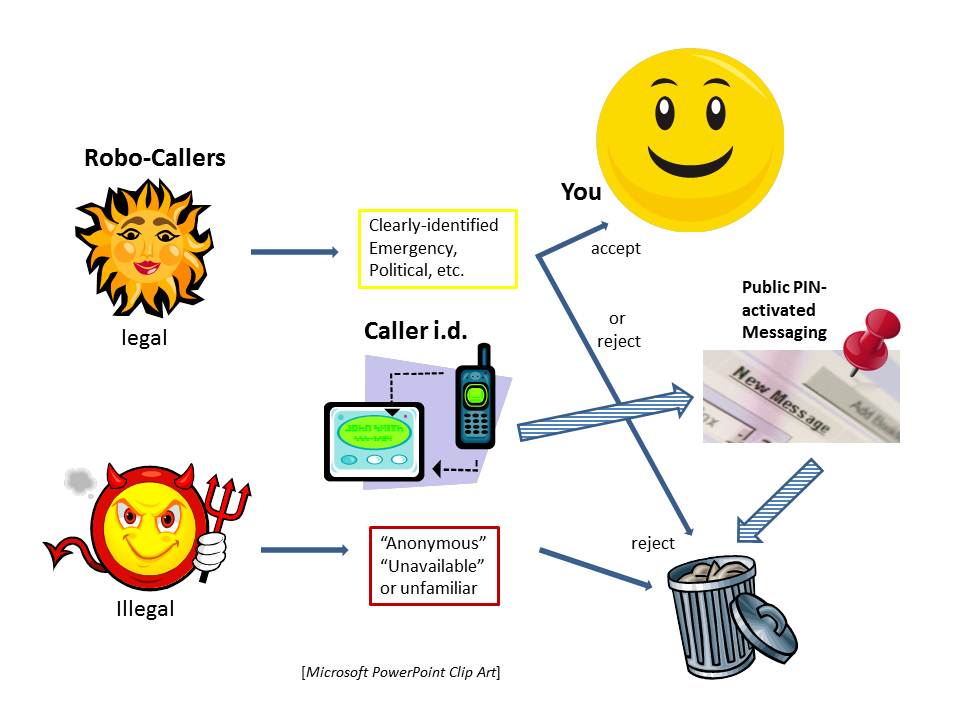
Caller i.d. is obtained, for landline or mobile phone. Caller chooses to not answer unfamiliar phone numbers or suspect identifications (such as “unavailable” or “anonymous”)---but still allows them to ring-through to messaging.
A commercial answering machine, service, or new software app is obtained which instructs the caller to make a human-level determination in order to contact the person/organization: such as “You have reached the phone number of Joe Smith. To speak with him or leave a message, please enter the following sequence: ‘A, 9, 7, X.’” (with the public PIN set and changed by the owner of that phone number whenever he or she wishes.)
All callers willing to have a human make the calls (and enter the publically-proclaimed PIN) can leave messages. All that do not enter the publicly-provided PIN when requested are rejected. The individual customer decides whether or not to “pick up” on clearly-identified emergency or otherwise legal robocalls.
4 comments
Andy Grouwstra • over 13 years ago
It will take robocall software companies less than 3 months to add a speech-to-text unit to their product. This solution will not last...
Dan Lyle • over 13 years ago
Thanks for your comment, Andy. Could you tell me the basis for your conclusion that a spoken PIN could be deciphered by the robocall programs within 3 months? I have no doubt that artificial intelligence on the level of a human being would counter this method eventually---but that would mean the equivalent of a human listening and responding, far in the future. The experts in the field that I've consulted say that even reaching about 10% functionality of a human intelligence is not achievable for several decades. at the least, using massively-paralleled computers, not simple robocall programs. Note that not only must the PIN be isolated and deciphered, but the instructions thereto must be responded to---which can be deliberately complicated, such as: "...enter A, Q, W, and 3---preceded by star." Robo-responses on the web are still being countered successfully by visually-distorted letters/numbers which must be input by the human applicant as "proof of humanity." You're correct that eventually artificial intelligence will render all these methods of stopping robocalls mute, but that will require not just rudimentary identification of a set of number/letters in a verbal or visual instruction, but response also on the level of a human----the equivalent of a human responding to the instructions. Of course they can just have a human sit there and listen/respond to each recipient's instructions, but that stops their robocall mechanical advantage.
D S • over 13 years ago
Dan L,
The basis for the comment is the same as the basis for every automated voice response system already in use (i.e., "Press or say your account number..."). That said, here's the approach, for example, for a cordless phone base station:
Provide potential callers who are not yet "trusted" (such as your doctor's office, or a new business that might need to call you) with a private "extension" in addition to your phone number. Every telephone database already supports that, and people are accustomed to the concept of an "extension".
Have a list of trusted callers that are automatically put through.
Have a list of blocked callers that are automatically dumped.
And then offer callers that are not on either of those lists the opportunity to key in the "extension", or press "O" to leave a message.
You could even configure the phone to move callers that use a valid "extension" to the trusted list. Put simply, a cordless base station now becomes its own little PBX. And of course, this could be virtualized by any service provider, e.g., to support mobile.
Finally, although some people claim that this would prevent "First-Amendment" robocalls from getting through, I have an absolute right to reject any call that I don't want, whether I do it, or have a machine do it for me.
Dan Lyle • over 13 years ago
Andy, please note that you did not answer the question I asked concerning your stated objection to my proposed solution. Also, my proposed solution is far simpler than yours, and much more likely to be implemented by the average user. Thanks for your interest in my proposed solution.